
01Design
Products
AI implementation

We know design.We build whatcomes next.

Detail of the hand-drawn Jungle pattern in greyscale: monstera and palm leaves built from rows of stitch-like dashes and small crosses.
Fig. 01. Jungle pattern, drawn mark by mark for Strange Forms, one of our own products. See the project.

We design and build digital products, integrate AI into real business workflows, and help businesses get discovered in the new web.

02The shift, in numbers

Adoption is broad. Implementation isn’t.

More people use AI every quarter, and almost every large organisation has tried it. Far fewer have turned it into working systems. Meanwhile, the way people find things online is changing underneath everyone.

  1. S/01

    17.8% of the world’s working-age population used a generative AI product in the first quarter of 2026.

    17.8 · Q1 2026 16.3 · END 2025 REST OF WORKING-AGE POP. 050100%

    Up from 16.3% at the end of 2025. Microsoft’s measure counts people aged 15–64 who used a generative AI product in the period, estimated from its own anonymised usage data and adjusted for device market share, internet access and population.

    Source: Microsoft AI Economy Institute, The state of global AI diffusion in 2026 (external site), 2026

  2. S/02

    88% of surveyed organisations use AI regularly in at least one business function.

    USE AI REGULARLY · 88 78 · A YEAR EARLIER NEARLY TWO-THIRDS NOT YET SCALING ≈ ⅔, APPROXIMATE 050100%

    Up from 78% a year earlier. But nearly two-thirds of respondents say their organisations have not yet begun scaling AI across the enterprise. Survey of 1,993 participants in 105 countries, June–July 2025.

    Source: McKinsey & Company, The state of AI in 2025: Agents, innovation, and transformation (external site), 2025

  3. S/03

    +15% more customer issues resolved per hour by support agents with access to an AI assistant.

    WITHOUT ASSISTANT = 100 WITH ASSISTANT = 115 +15% ISSUES RESOLVED PER HOUR, INDEXED

    One study, one setting: more than 5,000 customer-support agents at a single software company. The gains were concentrated among less experienced workers; the most experienced saw small gains. A measured result, not a general rule.

    Source: Brynjolfsson, Li & Raymond, The Quarterly Journal of Economics, Generative AI at Work (external site), 2025

  4. S/04

    8% of Google visits with an AI summary led to a click on a traditional result, against 15% without one.

    NO AI SUMMARY 15 / 100 VISITS WITH AI SUMMARY 8 / 100 VISITS +1 CLICK INSIDE SUMMARY ■ CLICK ON A RESULT

    Links inside the AI summary itself were clicked in 1% of visits. Browsing data from 900 U.S. adults, March 2025. It describes this panel’s behaviour, not every search.

    Source: Pew Research Center, Google users are less likely to click on links when an AI summary appears in the results (external site), 2025

These numbers describe trends, not your business. They are why we think practical implementation and clear, well-structured content matter now. They are not a promise of results.

03What we do

One studio. Three ways in.

Most work starts in one of these places and ends up touching the other two. Good products need to be found; useful automation needs a usable interface.

  1. 01. Digital products

    We design and build digital products that solve real problems, from focused business tools to complete web applications.

    • Product strategy
    • UX and UI design
    • Interface design
    • Prototyping
    • Application development
    • Product iteration
    01 STRATEGY02 EXPERIENCE03 INTERFACE04 CODEONE TEAM, EVERY LAYERDECISIONS TRAVEL DOWN WITHOUT A HAND-OFF
    One team across every layer, so decisions made at the top survive to the bottom.
  2. 02. AI transformation and automation

    We identify where AI can make work better, then build the workflows and tools that make it happen.

    • Process analysis
    • Workflow automation
    • AI-assisted operations
    • Internal tools
    • Integration with existing systems
    INTAKE01SORT02DRAFT03REVIEW04APPROVE05SEND06AI-ASSISTEDPEOPLE DECIDELIME = AUTOMATED OR AI-ASSISTED · OUTLINE = HUMAN JUDGMENT
    Automate the steps that repeat. Keep people at the points where judgment matters.
  3. 03. Digital visibility

    We help businesses build a stronger presence across search engines and the emerging AI-powered discovery ecosystem.

    • Technical SEO
    • Information architecture
    • Structured content
    • Answer-engine optimisation
    • Generative-engine optimisation

    We don’t promise rankings or AI citations. Nobody honestly can. We promise sound foundations and a clear record of what was changed and why.

    ONE SOURCE · YOUR SITETITLE + CLEAR HEADINGSSPECIFIC FACTS IN TEXTSTRUCTURED DATAANSWERS TO REAL QUESTIONSSEARCH RESULTSAI ANSWERSLINK PREVIEWSREAD BY PEOPLE AND MACHINES ALIKENO GUARANTEED PLACEMENT
    One clear, well-structured source, readable by people, search engines and AI systems alike.

How we work on each

04Experience meets new technology

New tools.Experienced hands.

A loose black pencil sketch of leaf shapes, the first pass of a pattern before any detail is drawn.
Fig. 02. Before any tool does anything: the sketch.

Good tools make more things possible. Experience helps you decide which things are worth building.

We bring years of professional design and digital experience into an AI-native way of working. That means better questions, clearer systems, stronger interfaces, and products built around real needs rather than technology for its own sake.

What experience decides

  1. What is worth building, and what isn’t
  2. How information should be structured
  3. When an interface is clear, and when it only looks finished
  4. Which problem is really being solved

What AI-native execution changes

  1. Prototypes in working code, not only pictures
  2. Complete products from a small, independent studio
  3. Repetitive steps handed to automation, with people kept in review
  4. Ideas tested against real use earlier in the process

The tools are new. Knowing what works isn’t.

05Selected work

We build and ship our own products.

The best evidence that we can build something is that we have. These are products we designed, built and run ourselves.

W/01

Live

Web app (installable PWA)

Brief Builder

A brief your client can actually fill in.
brief-builder-6jo.pages.devLive · captured 2026-10-15
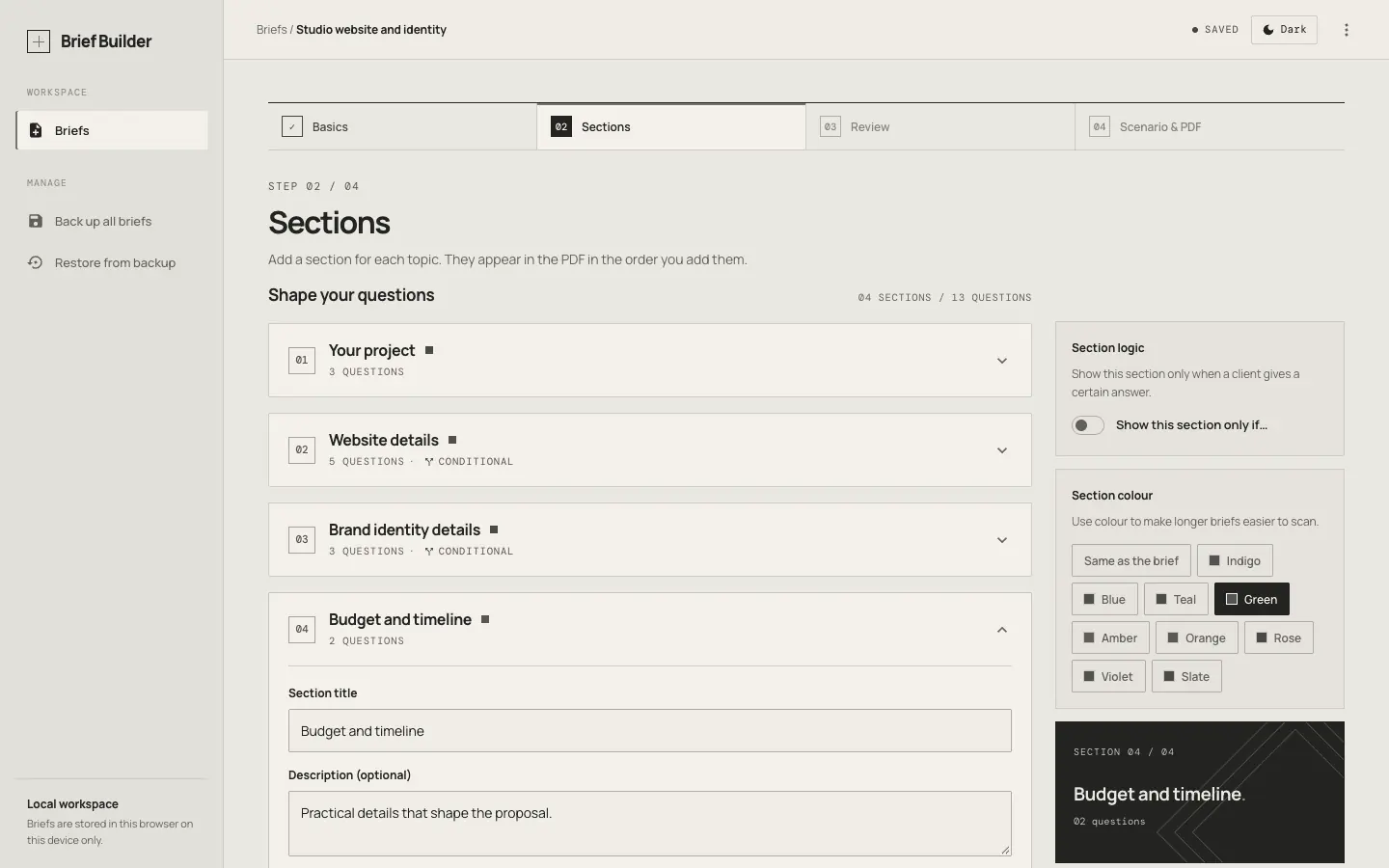
Brief Builder on desktop, Sections step: a brief called Studio website and identity with sections for the project, website details, brand identity details, and budget and timeline.
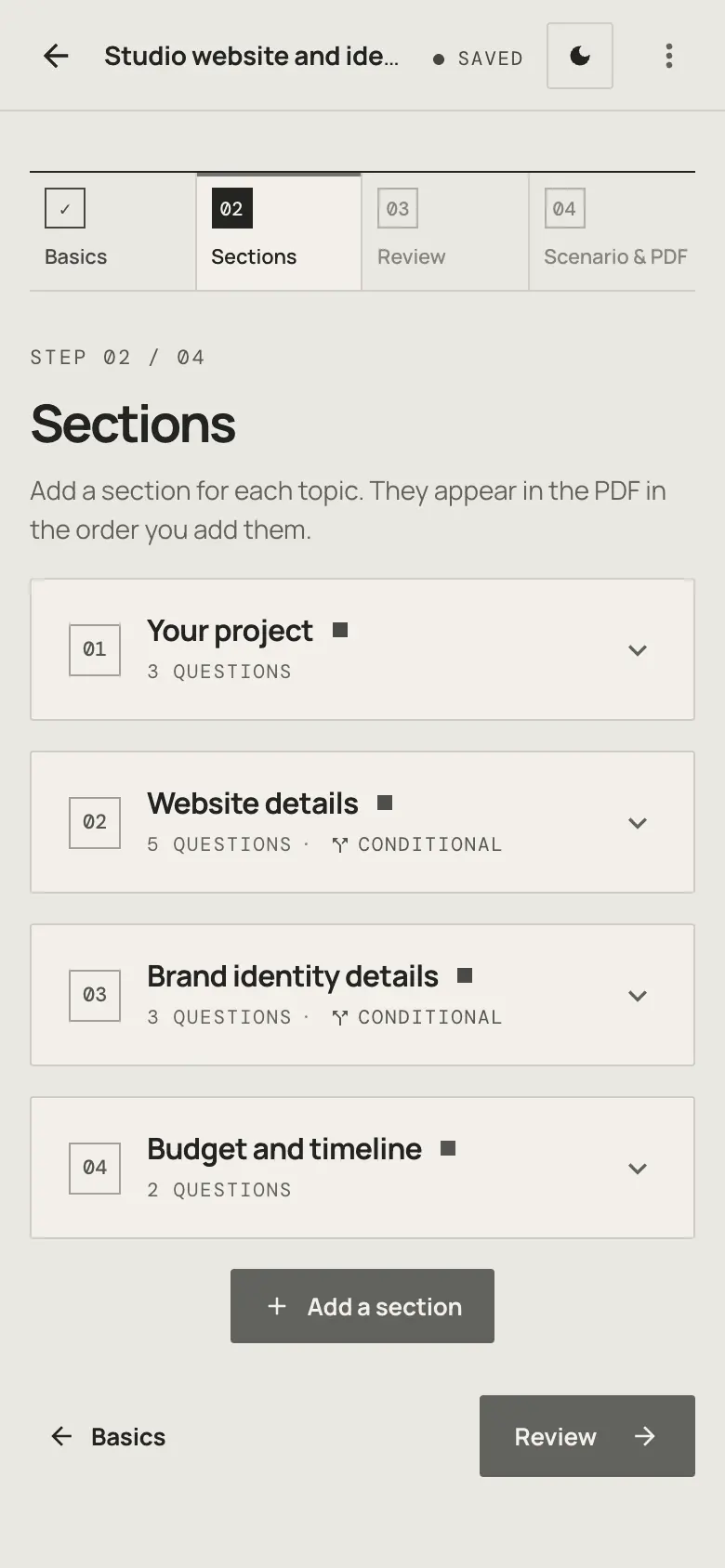
Brief Builder on a phone, showing the same brief’s Sections step.

Brief Builder helps freelancers put together a client questionnaire from reusable sections and send it as a fillable PDF. The client completes it in any PDF reader and sends it back. No accounts, no portal, no back-and-forth over email threads.

Problem
A good brief is the first real conversation of a project, yet it usually starts as a copied document or an online form the client has to sign up for. Questions that don’t apply get asked anyway, and the answers come back scattered.
What we built
Brief Builder turns the brief into something you assemble: choose the project type, add sections from a catalogue, let questions appear only when they apply, then export a tailored, fillable PDF. Everything stays in your browser.
  • Four-step flow
  • Reusable sections
  • Conditional questions
  • Tailored PDF
  • Safe edits
  • Private by design

W/02

Live

Product brand and static publishing system

Strange Forms

Drawn to look stitched. Built so nothing is made up.

strange-forms.pages.devLive · captured 2026-10-15
The Strange Forms home page: a crumpled dark green Jungle blanket with drawn leaves behind it, and the heading Patterned sherpa fleece blankets.
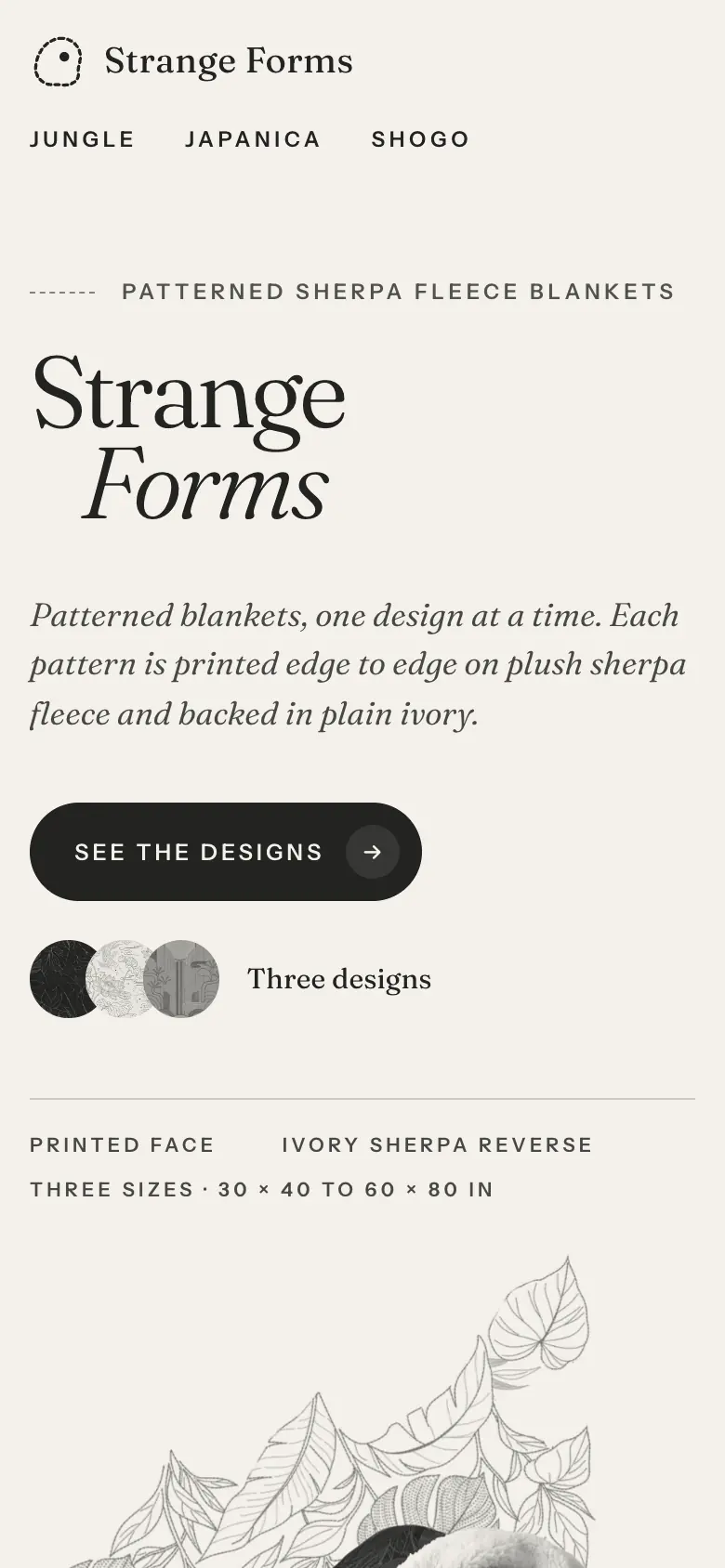
The Strange Forms home page on a phone.

Strange Forms is our own brand of patterned sherpa fleece blankets, and the publishing system we built to sell them. Each pattern is drawn by hand, mark by mark, to look like embroidery, then printed. The site presents each design and links straight to its page in the shop.

Problem
Small product sites drift. Prices go stale, placeholder text reaches production, and structured data claims things the page doesn’t show. For print-on-demand products, where the shop holds the real details, that drift is easy and costly.
What we built
We built a small static publishing system with strict rules. Content lives in validated Markdown, and the build refuses to invent anything: no price unless it is verified, no buy button without a real shop link, no draft in production. Every build is audited before it ships.
  • Hand-drawn patterns
  • Unknown stays unknown
  • Structured data that matches the page
  • Images handled once
  • Audited builds
  • Ready for more sites

All work

06How we build

Five stages. Usually more than one lap.

This is the shape most of our work takes. Real projects loop: what we learn in testing and after launch goes back into the design.

  1. 01

    Understand

    The problem, the people involved and the workflow as it runs today.

    Output: → Problem statement, workflow map

  2. 02

    Define

    The right solution and its constraints: what it must do, what it mustn’t, and what can wait.

    Output: → Scope, constraints, success measures

  3. 03

    Design

    The experience and the system behind it, together, so neither is an afterthought.

    Output: → Flows, interface, data model

  4. 04

    Build

    Working software, tested early and refined against real use.

    Output: → Tested, working product

  5. 05

    Deploy

    Release, measure what happens, and improve what matters.

    Output: → Live product, measured changes

Proposed sequence. Stages overlap and repeat. Measure → refine: stage 05 feeds back into stage 03.

07Insights

Notes from the work.

Practical thinking on design, AI, digital products, automation, and being found in an increasingly AI-driven web.

The first articles are on their way.

We will publish here when we have something useful to say. These are the subjects we work on and expect to write about:

  1. T/01Design judgment in AI-assisted work
  2. T/02Shipping small products
  3. T/03Practical workflow automation
  4. T/04Structured content and being found
  5. T/05Evidence, not hype, in AI discovery

All insights

08Start here

Have something worth building?

Tell us what you’re trying to improve, build or figure out. We’ll help you work out what makes sense.

Start a conversation